
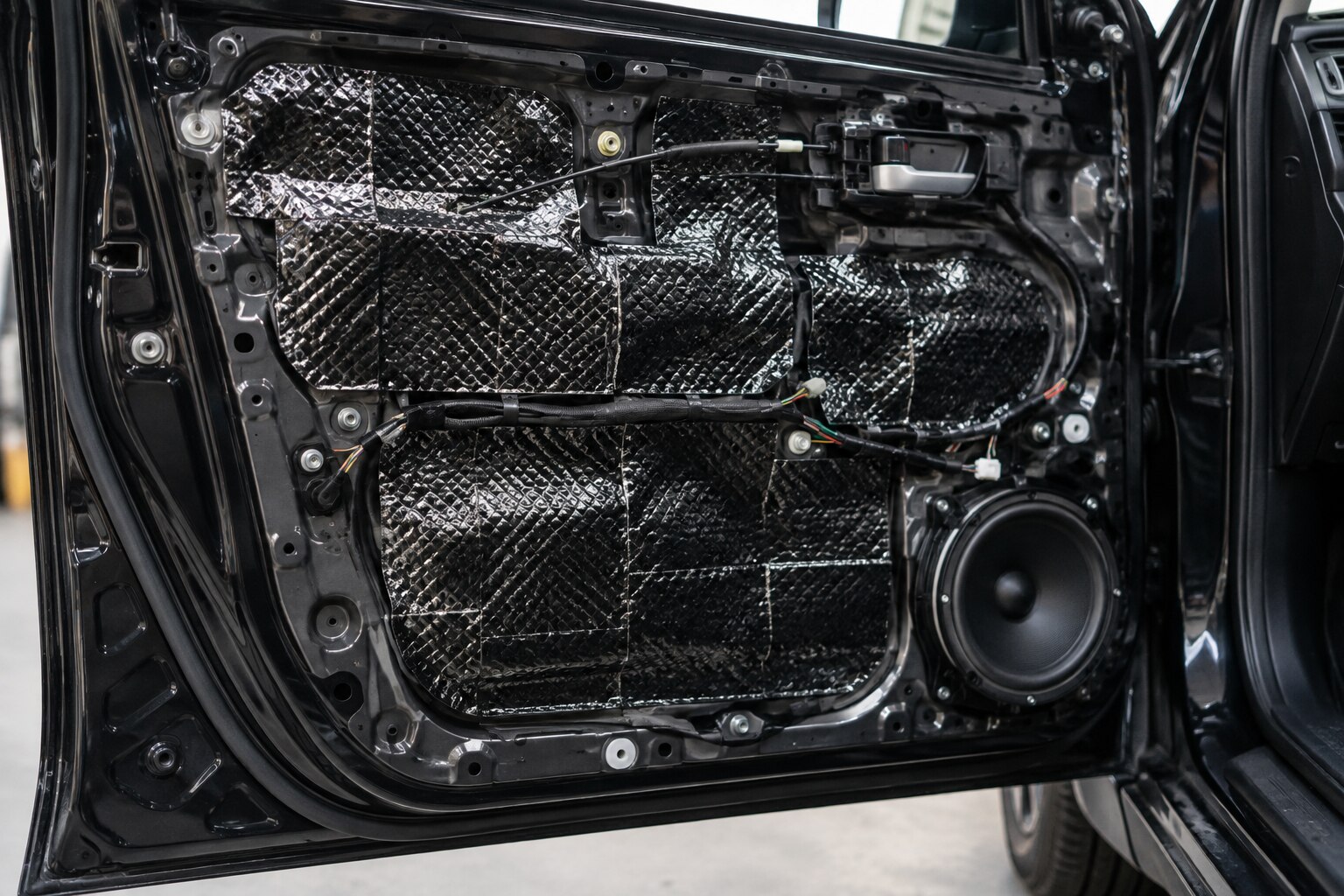
A vibrating door panel can turn clean bass into buzzes, rattles and lost speaker energy, but adding material without diagnosing the fault can waste weight and money. You will learn how to identify the source, match each material to its job, check installation risks and judge whether the result genuinely improves sound.
Key takeaways
- Use damping to reduce panel flex, rattles and sound leakage.
- Apply constrained-layer material to broad metal panels, not moving mechanisms.
- Check window travel, drain holes, wiring and airbag components before sealing the door.
- Compare recordings at the same volume before and after treatment.
What door damping fixes—and what it cannot
Car door damping mainly reduces structure-borne vibration: metal panels flex, buzz and transmit speaker energy into the door. A bonded viscoelastic layer flexes with the metal and dissipates some mechanical energy as heat.
Airborne noise is sound travelling through air, while acoustic absorption converts reflected sound into heat inside a porous material; neither is the same job as damping.
| Treatment | Solves | Does not solve |
|---|---|---|
| Damping sheet | Panel resonance and buzz | A damaged speaker or incorrect equalisation |
| Speaker seal and barrier | Air leaks and some airborne transmission | Tyre noise through the floor or wind through seals |
| Acoustic absorber | Reflections inside a cavity | Lack of amplifier power |
Use a bass-heavy track at a controlled, moderate volume. Listen with the door closed, then open it while keeping your head and volume consistent: a buzz that changes or disappears points to the door skin, trim or mounting area. Press suspected trim lightly; if the noise stops, loose trim is responsible.
A blown speaker still distorts with the door open, while tyre or road noise remains when the track is paused and the vehicle moves. Damping cannot repair that speaker, correct equalisation, create amplifier power or remove all wind and road noise. Those problems require speaker, equipment, seals, barriers or absorbers instead.
How treatment changes the door’s behaviour around a speaker
The biggest gain comes from treating broad, lightly stiffened areas: the outer door skin behind the speaker and the inner metal door panel. Both can resonate and flex, so some speaker energy moves the door instead of producing sound.
Constrained-layer damping uses butyl rubber and aluminium sheet bonded firmly to the metal. When the panel bends, the viscoelastic butyl layer is forced to shear between the metal and aluminium, converting part of that motion into heat. The result can be lower door-panel resonance, fewer trim rattles and a more stable speaker mounting surface.
The treatment only works where it is properly coupled to the panel. Check these installation points:
- Roll the sheet firmly onto clean metal to remove air pockets.
- Press down edges so loose adhesion and edge lift cannot create new buzz-prone areas.
- Cover service openings with properly supported, sealed panels to limit air leakage from the speaker’s rear wave.
- Keep the speaker adaptor airtight, rigid and sealed against the inner door panel.
- Add a closed-cell gasket or seal at the adaptor-to-speaker and adaptor-to-door interfaces.
An airtight adaptor creates a controlled interface; damping does not. A loose speaker, incorrect polarity or an unsealed enclosure can still produce weak, hollow or poorly controlled bass after extensive panel treatment. Damping reduces mechanical losses and rattles, but it cannot correct those installation faults.
Which material belongs on which part of the door
Match the material to the failure: damping controls panel vibration, foam stops contact buzzes, and mass-loaded vinyl acts as an airborne sound barrier. They are not interchangeable.
| Material | Door location | Job |
|---|---|---|
| Butyl rubber/aluminium constrained-layer sheet | Clean, resonant outer skin behind the speaker and inner metal panel | Bonds to metal; its viscoelastic layer shears as the panel bends and dissipates vibration |
| Closed-cell foam | Selected door-card contact points and rubbing interfaces | Stops trim-to-metal or trim-to-trim buzzes; it is not panel damping or a heavy airborne-noise barrier |
| Mass-loaded vinyl | Supported inner-door area or properly sealed service-hole covers | Adds flexible mass to block airborne transmission; it needs support and sealing, and must not obstruct a moving door |
Treat the broad, lightly stiffened outer skin behind the speaker and the inner panel first. Cover service-hole covers with a rigid, sealed closure where appropriate, then place small foam pieces only at confirmed door-card contact points.
Covering every square centimetre wastes material and adds weight; a small patch on an already rigid area has little leverage.
Doubling barrier mass does not guarantee a 6 dB improvement in the vehicle. That mass-law estimate applies only under restricted conditions; openings, door seals, panel coincidence and flanking paths can dominate. A barrier fitted without sealing leaks, or mounted where the window mechanism moves, solves neither airborne transmission nor rattling.
What must be checked before material goes inside the door
A door that sounds better but traps water or restricts the glass is a failed installation. Inspect the factory layout before cutting material.
- Locate the door water drains along the bottom edge and keep every opening clear. Blocked drains retain water, promoting corrosion and electrical faults.
- Test window-regulator clearance and run the glass through its full travel. Material must not touch the window mechanism, wiring, latch cables or moving linkages.
- Identify side-impact components and airbag components before placing anything nearby. Do not cover, move or interfere with safety hardware.
- Measure speaker depth, check fastener access and inspect door-card clips. A thick layer can prevent the speaker, trim or fasteners from seating correctly; broken door-card clips can create new rattles.
- Remove oil, dust, loose paint and moisture from the bonding surface. Roll the sheet firmly onto clean metal so it couples to the panel without air pockets or edge lift.
- Check the product’s stated temperature rating and adhesive compatibility. Viscoelastic damping changes with temperature: a layer that works well at room temperature can become too soft in heat or too stiff in cold.
- Reject unidentified old asphalt-based material if it softens, migrates or smells when heated. Modern butyl sheets are usually more stable, but the product specification decides suitability.
- Calculate added mass before covering large areas: areal mass in kg/m² multiplied by installed area gives kilograms added. Extra weight increases loads on hinges, check straps and trim fasteners, especially with multiple layers.
How to judge whether the finished job improved sound
Play the same bass-heavy music or test signal before and after the automotive door-damping installation. Use the same listening position and comparable volume, then check for reduced panel buzz, fewer trim rattles, tighter bass and more stable speaker output. A lower sound-pressure reading alone proves nothing if speaker output, equalisation or your seating position changed.
| Observation | What it suggests | Decision |
|---|---|---|
| Clearer bass with less door vibration | The panel is wasting less speaker energy | The treatment improved the installation |
| Lower volume but weaker speaker output | The measurement reflects reduced output, not better damping | Recheck gain, equalisation and polarity |
| No change, or new rattles | Coverage, adhesion, mounting or trim fit remains inadequate | Request an inspection before paying for more material |
Ask the installer to show you:
- Which resonant panels were treated, including the outer skin and inner metal panel
- How service openings were sealed without blocking drains
- How the speaker adaptor was made airtight
- How window mechanisms, wiring, latch cables and moving parts were protected
ASTM E756 reports damping-related properties under specified test conditions; it does not predict a complete vehicle result across every temperature, frequency and door design. Treat a quoted damping figure as material data, not proof of cabin improvement.
RS Car Accessories can be considered for a local assessment, but compare the inspection, material specification, coverage map and final before-and-after sound test rather than accepting “sound deadening” as a complete technical description.
Frequently asked questions
What problems does car door damping fix?
It reduces structure-borne vibration, panel flex, rattles and some sound leakage from the door. It cannot repair a damaged speaker or replace proper tuning.
How does damping change a door around its speaker?
It adds stiffness and loss to the door structure, so less speaker energy becomes panel vibration and more remains as acoustic output.
Which damping materials belong on each part of a car door?
Use bonded viscoelastic constrained-layer material on broad metal panels, closed-cell foam to manage contact points, and suitable moisture-resistant barriers where needed.
What should be checked before installing damping inside a door?
Check window travel, lock and handle cables, wiring, drain holes, side-impact components, airbag parts and the factory moisture barrier.
How can you tell whether door damping improved sound quality?
Use the same tracks, source, listening position and volume before and after installation, then compare reduced rattles, tighter bass and clearer vocals.