
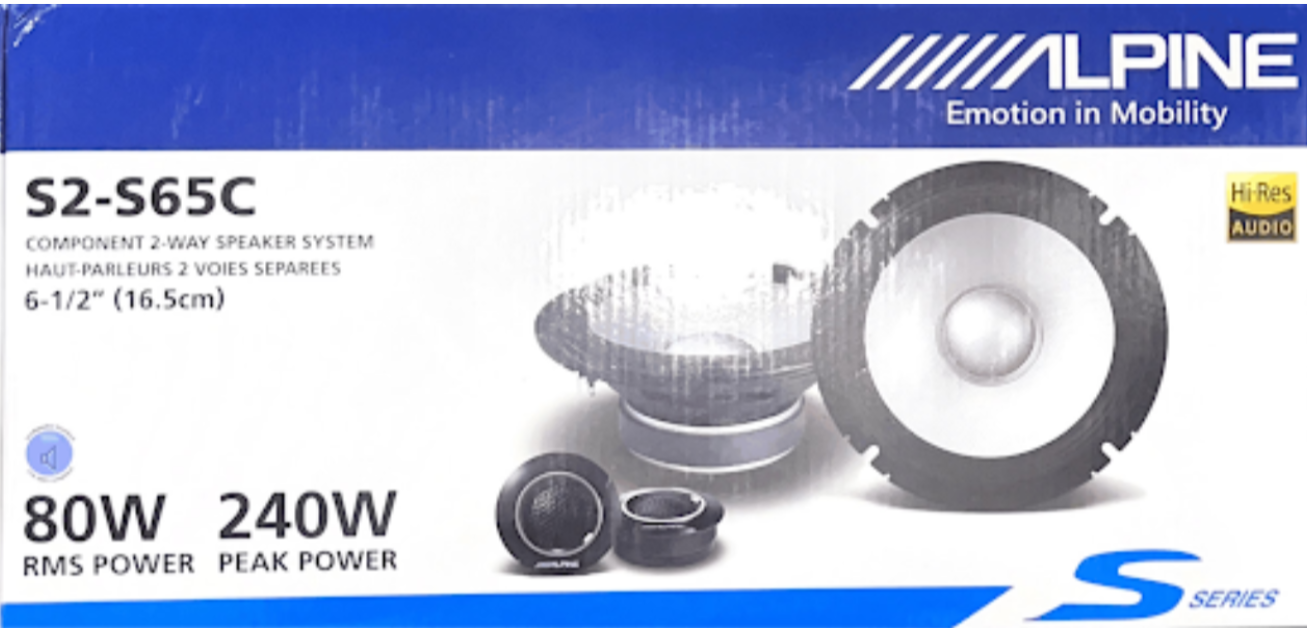
Factory audio systems are designed around cost, packaging, and broad customer preferences. They may be perfectly adequate for casual listening, but owners who want greater clarity, stronger detail, or improved performance at higher volumes often consider upgrading their car speakers.
Choosing speakers based solely on brand name, size, or advertised power can lead to an underwhelming result. The entire audio system needs to work together.
Identify What Is Missing From Your Current Audio
Start by listening critically.
Does the system lack vocal clarity? Does the sound become harsh when the volume increases? Is bass weak? Do instruments blend together?
The problem you hear should influence the upgrade.
Replacing speakers simply because they are factory-fitted does not guarantee that every weakness will disappear.
Component Speakers and Coaxial Speakers Work Differently
Component speaker systems separate sound reproduction across individual drivers, commonly using a woofer and tweeter with suitable frequency management. This arrangement provides more flexibility for sound staging and placement.
Coaxial speakers combine multiple drivers into a single assembly and can provide a practical upgrade in appropriate applications.
Neither category is automatically correct for every vehicle.
Installation location, available space, amplification, budget, and listening goals should determine the choice.
Power Matching Is Important
A speaker's power rating should not be viewed in isolation.
The output capabilities of the factory head unit, aftermarket head unit, or amplifier should be considered when choosing speakers.
Underpowered or poorly matched systems can struggle to deliver the expected performance. Proper gain settings and tuning are also essential.
Installation Can Change the Result
Even high-quality speakers may disappoint when installed poorly.
Mounting stability, speaker adapters, polarity, wiring, door sealing, and damping can influence the final sound.
Vehicle interiors are acoustically challenging because glass, seats, dashboards, carpets, and door panels reflect and absorb sound differently.
Professional tuning therefore matters after hardware installation.
Do You Need an Amplifier
Not always.
Some speaker upgrades are designed to work effectively with factory systems, while others benefit significantly from external amplification.
If you frequently listen at higher volumes or want greater dynamic range, an amplifier may become useful. It should be selected based on system requirements rather than added automatically.
Should You Add a Subwoofer Too
A subwoofer handles lower frequencies that door speakers may struggle to reproduce convincingly.
It can improve fullness and depth without necessarily making the system excessively loud.
For many listeners, a properly integrated subwoofer actually allows the main speakers to work more effectively. The goal should be controlled bass that blends with the music.
Listen for Balance Rather Than Maximum Loudness
When evaluating car speakers, focus on vocal detail, instrument separation, tonal balance, bass control, and comfort during longer listening sessions.
Nagpur motorists who spend considerable time commuting through the city or travelling across Maharashtra may benefit more from a refined system that remains comfortable for extended journeys than one optimized purely for maximum output.
RS Car Accessories can be considered when comparing speaker configurations, amplification, damping, and related audio upgrades.
A good system should make familiar music sound more natural. Speaker selection matters, but installation and tuning ultimately determine how successfully those speakers perform inside the vehicle.
Keywords