
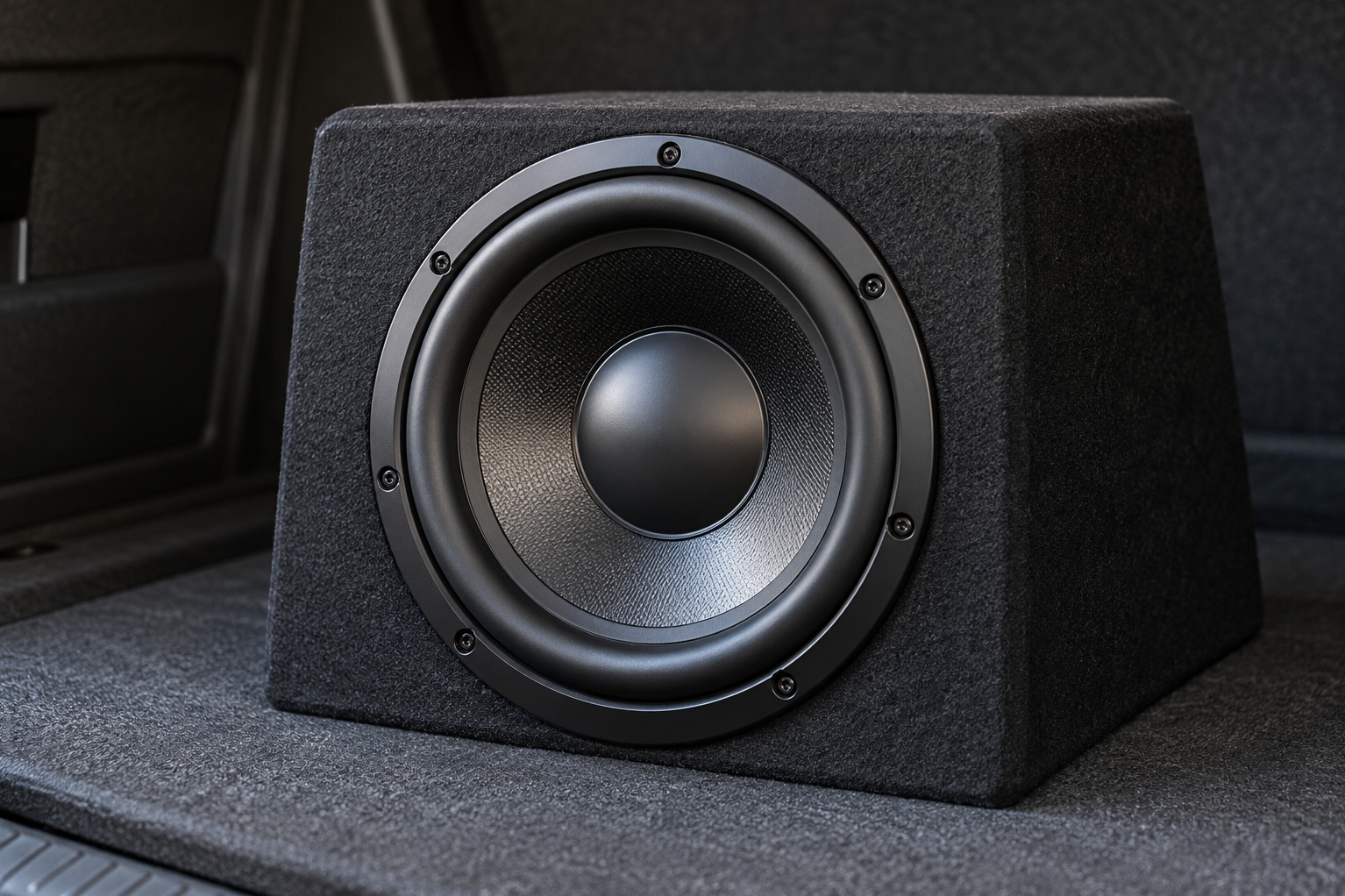
Many factory audio systems can reproduce vocals and mid-range frequencies reasonably well but struggle with deeper bass. A car subwoofer is designed specifically to reproduce low frequencies, adding depth and impact that standard door speakers may not provide effectively.
That does not mean every vehicle needs a huge enclosure or extremely loud bass. Modern subwoofer installations can be designed around different music preferences, cabin sizes, and luggage-space requirements.
Decide What Kind of Bass You Want
Before comparing products, define the listening experience you prefer.
Some drivers want subtle low-frequency reinforcement that makes music sound fuller. Others enjoy stronger bass that can be physically felt.
These requirements can lead to very different equipment choices.
The subwoofer size, enclosure design, amplifier power, installation location, and tuning all influence the final result.
Space Is an Important Consideration
Traditional subwoofer enclosures can occupy significant boot space.
For owners who regularly carry luggage, alternative configurations may be more practical. Compact powered subwoofers and selected under-seat solutions can provide additional low-frequency performance while preserving more usable storage space, subject to vehicle compatibility.
Before installation, consider how frequently you use the boot and whether seats need to fold regularly.
Amplification Needs to Be Matched Properly
Most dedicated subwoofers require suitable amplification.
Matching should consider impedance, power handling, amplifier capabilities, wiring, and intended output. Simply choosing the highest advertised wattage is not a reliable way to build a balanced system.
The electrical demands of more powerful systems also deserve consideration.
Integration Matters More Than Excessive Bass
A well-tuned subwoofer should blend with the front and rear audio rather than sounding like a separate source in the boot.
Crossover settings, gain, phase, speaker tuning, and installation all affect integration.
When bass dominates vocals and instruments, the system may sound impressive briefly but tiring during longer journeys.
Door Damping May Improve the Overall System
If the main speakers are installed in doors that vibrate significantly, adding a subwoofer will not automatically correct the rest of the system.
Appropriate door damping can help manage panel resonance and improve the operating environment for speakers.
This can produce a more controlled overall result.
Can a Subwoofer Work With a Factory Stereo
In many vehicles, yes, although the integration method varies.
Some installations can retain the factory head unit while adding suitable signal integration, amplification, and a subwoofer. Modern factory audio systems can be more complex, so compatibility should be checked before work begins.
Questions to Ask Before Installation
Before purchasing a car subwoofer, discuss enclosure size, amplifier requirements, boot-space impact, wiring, expected bass characteristics, factory-system integration, and tuning.
For owners in Nagpur, Maharashtra, RS Car Accessories can assess the existing audio setup before recommending a configuration.
A subwoofer should solve a specific limitation in the system. When selected and tuned correctly, it can provide deeper, cleaner low frequencies while allowing the rest of the music to remain clear and balanced. That is generally more valuable for everyday listening than simply choosing the biggest subwoofer that fits inside the car.
Keywords